by Chibuike Nkwede
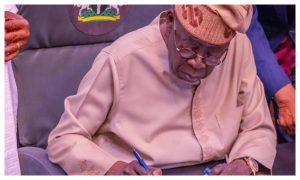
President Bola Tinubu has approved a ₦3.3 trillion payment plan aimed at clearing longstanding legacy debts in Nigeria’s power sector, a move expected to stabilise electricity generation and improve power supply across the country.
The approval was announced on Sunday in a statement issued by the President’s spokesperson, Bayo Onanuga, who said the payment plan followed a thorough verification of the country’s power sector legacy debt, which has persisted for more than a decade.
According to the statement, the ₦3.3 trillion figure has been agreed upon as a full and final settlement, in addition to the existing ₦501 billion pioneer bond earlier introduced to settle part of the debt.
The Presidency noted that implementation of the payment plan has already commenced, with 15 power plants signing settlement agreements worth ₦2.3 trillion.
It further disclosed that the Federal Government has already raised ₦501 billion to fund the payments, out of which ₦223 billion has been disbursed, while further payments are underway.
The statement explained that the intervention is expected to strengthen the entire power value chain, leading to more stable electricity generation and improved service delivery for Nigerians.
It added that with power plants adequately supported, electricity reliability would improve, while increased investment and job creation are also expected as the sector stabilises.
Commenting on the development, the Special Adviser to the President on Energy, Olu Arowolo-Verheijen, said the programme goes beyond debt repayment.
According to her, the initiative is aimed at restoring confidence across the power sector by ensuring that gas suppliers are paid, power plants remain operational, and the electricity system functions more efficiently.
She added that the debt settlement forms part of broader reforms already underway, including improved metering and service-based tariffs that link what consumers pay to the quality of electricity supplied.
However, the Association of Power Generation Companies (APGC) has expressed reservations over the development, alleging that the Federal Government reduced the legacy debt from ₦6 trillion to ₦3.3 trillion.
Reacting to the payment plan, the Chief Executive Officer of APGC, Dr Joy Ogaji, questioned the verification process, asking, “Is verification unilateral in a bilateral agreement?”
The development comes amid renewed criticism of the Federal Government’s handling of the nation’s persistent power crisis.
Former Labour Party presidential candidate, Peter Obi, had recently criticised President Tinubu’s management of the sector, describing the continued poor power supply as evidence of unfulfilled campaign promises.
Despite repeated assurances, Nigerians have continued to experience epileptic power supply nationwide, with no significant improvement in recent months.
Tinubu had, during his campaign, promised to fix electricity supply within four years. However, more than two years into his administration, the crisis in the power sector remains a major concern.
This latest intervention is therefore being seen as a crucial step toward reviving the sector and restoring public confidence in the country’s electricity supply system.