By Chibuike Nkwede
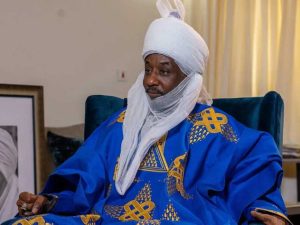
The Emir of Kano, Muhammadu Sanusi II, has raised concerns over Nigeria’s fiscal trajectory, warning that continued borrowing following the removal of fuel subsidies could undermine the expected benefits of ongoing economic reforms.
Speaking at the fifth annual lecture organised by TheNiche in Lagos, the former Governor of the Central Bank of Nigeria questioned why the anticipated fiscal relief from subsidy removal has not translated into reduced borrowing or tangible improvements in public welfare.
Sanusi described the situation as a “fiscal contradiction,” noting that the elimination of subsidy payments should ordinarily ease pressure on government finances.
He said, “We’ve removed the subsidy. We’re not spending it. What we should not see is fiscal contradictions. You cannot remove the subsidy and continue borrowing. If you’re not paying the subsidy and you’ve got the money, why are we still borrowing? What are we borrowing for?”
His remarks come amid renewed debate over government borrowing, following a request by President Bola Ahmed Tinubu seeking legislative approval for a 516 million dollar loan to support sections of the Sokoto–Badagry Superhighway project. The proposal was conveyed to lawmakers in a letter read by Senate President Godswill Akpabio, who said the project is designed to link Nigeria’s North-West and South-West regions.
The borrowing plan has attracted criticism from several quarters, including former Vice-President Atiku Abubakar, who acknowledged the project’s importance but advised the government to consider alternative funding mechanisms rather than increasing the country’s debt burden.
Sanusi emphasised that economic reforms must extend beyond policy declarations and produce measurable outcomes for citizens, warning that failure to do so could weaken public confidence.
While reiterating his longstanding support for the removal of fuel subsidies, he questioned the sequencing of key policy decisions, particularly the simultaneous implementation of subsidy removal and foreign exchange liberalisation.
According to him, years of dependence on subsidies and controlled exchange rates created structural distortions that made economic adjustment unavoidable. However, he stressed that such reforms require careful coordination and fiscal discipline to deliver the desired results.
Sanusi also highlighted recent gains in domestic refining, noting that Nigeria is gradually reducing its dependence on imported petroleum products while increasing export capacity. Despite this progress, he warned that weak policy coordination has limited the overall impact of reforms.
He further argued that the volatility experienced in the foreign exchange market could have been mitigated with better timing, suggesting that monetary tightening should have preceded or accompanied exchange rate liberalisation.
On the issue of debt sustainability, Sanusi cautioned against a situation where government revenue is largely consumed by debt servicing, questioning the long-term viability of such a fiscal path.
He also underscored the importance of integrity in public service, maintaining that public office should not be viewed as a means of personal enrichment, and pointing to leading industrialists as examples of wealth creation through private enterprise.
Also speaking at the event, Abia State Governor, Alex Otti, linked Nigeria’s current economic challenges to decades of governance failures and declining civic engagement.
Otti said rising poverty, unemployment, and institutional decline are the cumulative consequences of poor leadership choices over many years, stressing that meaningful change would require sustained effort and active citizen participation.
He warned that voter apathy and disengagement from the political process have contributed significantly to governance challenges, urging Nigerians to take a more active role in shaping the country’s future.
The governor noted that democracy extends beyond voting during elections, calling on citizens to critically evaluate candidates and their policy directions.
Reflecting on his administration, Otti pointed to improvements in infrastructure and increasing investor confidence as evidence that sound governance can drive economic renewal.
Having a foresight to the 2027 general elections, he emphasised that the choices made by voters would have far-reaching implications for economic stability, employment, and national development.